Tesla Roadster Thruster Claims: A Flying Car or Track Spectacle?
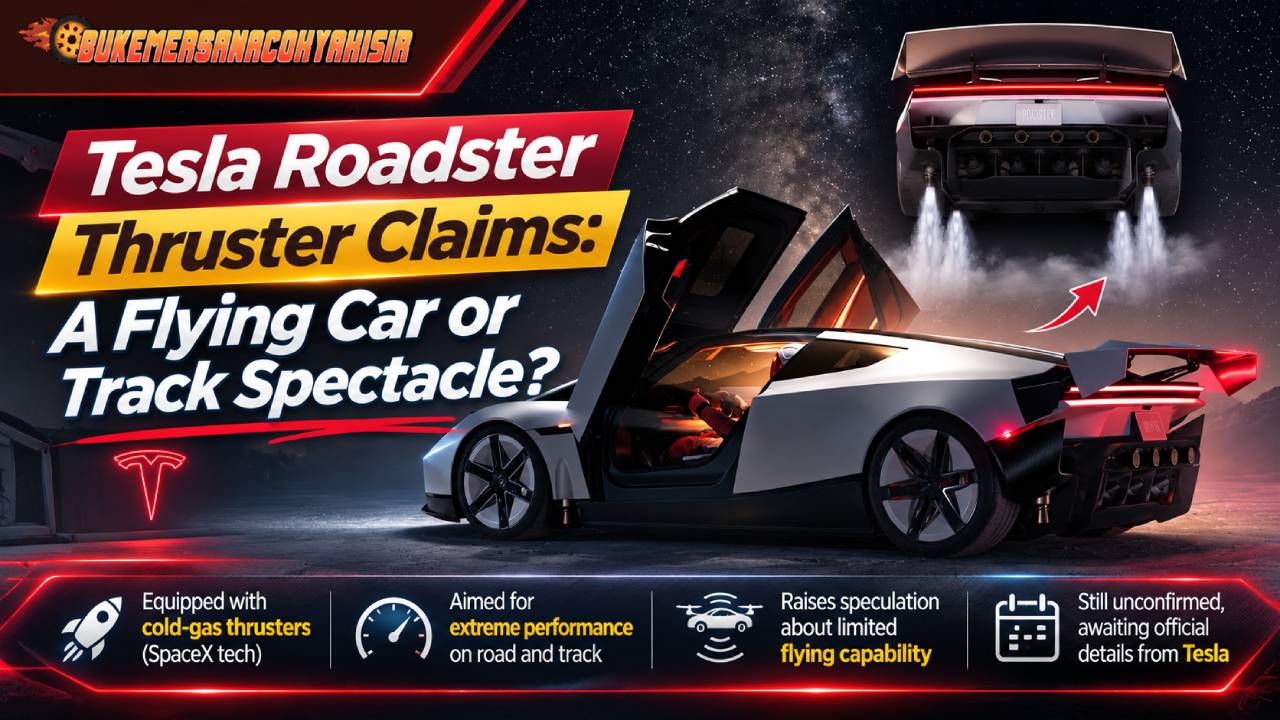
Bukemersanacokyakisir – A sports car accelerates, leaves the ground, and performs manoeuvres usually associated with aircraft. It sounds like a cinematic sequence. However, the Tesla Roadster thruster claims described in the supplied account raise practical engineering questions beneath the spectacle. How does the propulsion work? Can the performance be repeated? And what separates a brief airborne demonstration from useful flight? The proposed technology deserves examination, but advertised figures should remain distinct from independently verified results. Battery performance, aerodynamic assistance, and compressed-gas propulsion also involve different operating limits. Understanding those differences makes the Roadster story more interesting than simply asking whether a car can fly.
The Electric Powertrain Remains Central to the Story
The described specification centres on a battery of roughly 100 kWh and two rear-mounted motors producing a combined 1,360 bhp. Claimed driving range is approximately 300 miles. Meanwhile, charging is presented as reaching 500 kW, with a roughly ten-minute session taking the battery from 10 to 80 percent. These remain figures requiring confirmation through final specifications and testing. In particular, peak charging power does not indicate the rate maintained throughout a session. Battery temperature, charger capability, and the charging curve all influence elapsed time. For an owner, repeatable performance and dependable charging would matter just as much as a headline power figure.
Fan-Assisted Downforce Could Address the Traction Problem
Delivering enormous power is only useful when the tyres can transmit it to the road. Consequently, the described Performance version uses fans and movable side skirts to generate suction beneath the car. Unlike conventional wings, fan-generated downforce does not depend solely on forward speed. That could help during the opening moments of acceleration, when traction often limits powerful vehicles. However, performance would still depend on the effectiveness of the underbody seal, road conditions, and tyre behaviour. An upside-down demonstration would also require carefully controlled circumstances. Such a display illustrates a particular capability rather than proving the system works equally well on every surface.
Active Aerodynamics Bring Their Own Engineering Trade-Offs
At higher speeds, the account describes deployable front and rear wings providing aerodynamic assistance. A lower-drag setting would serve a different purpose during straight-line running. The underlying compromise is familiar: aerodynamic grip can improve cornering, while drag increases the energy needed to maintain speed. Therefore, managing airflow involves more than fitting larger wings. A successful system must coordinate aerodynamic balance with braking, steering, and suspension behaviour. Moving components also introduce questions about reliability and maintenance. For drivers, the real benefit would be predictable handling as conditions change. Dramatic bodywork movements are interesting, but consistent vehicle behaviour is the more meaningful achievement.
Baca Juga : Jack Campbell Hospitalized After Scary Neck Injury Against Vikings
Cold-Gas Thrusters Add Propulsion Beyond the Tyres
The proposed Thrust version introduces compressed gas stored in a composite-overwrapped pressure vessel, commonly abbreviated to COPV. Releasing that gas through nozzles generates thrust through the same action-and-reaction principle used by other reaction propulsion systems. Importantly, cold-gas thrusters do not require combustion. Describing them as fuel-burning rocket engines would therefore be misleading, although cold-gas systems are used in spacecraft propulsion. On a car, rearward-directed jets could supplement the force produced through the driven wheels. However, their contribution depends on gas pressure, flow rate, and nozzle design. Without those details, extraordinary acceleration claims remain difficult to evaluate independently.
Sub-Second Acceleration Is Only Part of the Performance Picture
The supplied account describes a sub-one-second 0–60 mph target for the Thrust configuration. Yet the acceleration run is only one part of its operating cycle. Compressed gas is a finite resource, and pressure changes as the supply is discharged. Consequently, repeatability becomes a central question. How many runs are available, and what servicing is needed between them? The account also describes a lengthy repressurisation process using a suitable nitrogen supply. That would make the ownership experience very different from simply recharging an electric car. Any comparison with conventional hypercars should therefore consider preparation time alongside the quickest advertised sprint.
Brief Airborne Manoeuvres Do Not Establish Practical Flight
The described Rocket configuration adds another pressure vessel and multiple thrusters to control movement while airborne. In principle, carefully managed thrust can influence a vehicle’s orientation and motion. However, a short demonstration does not establish sustained flight, useful range, or safe operation in ordinary surroundings. Those are separate engineering challenges. Payload, available gas, control reliability, and landing conditions would all matter. Furthermore, the account describes an unoccupied demonstration and restricted availability. That leaves important questions about passenger operation unanswered. Calling the vehicle a flying car may capture attention, but buyers would need a much clearer definition of what its airborne capability actually allows.
Road Legality and Delivery Details Matter to Buyers
The account distinguishes the proposed Performance, Thrust, and Rocket configurations, with the more extreme versions described as having restricted use. Those distinctions matter because spectacular capabilities do not automatically translate into public-road approval. Approval requirements also vary between markets. Meanwhile, a deposit is not equivalent to a confirmed delivery date or a guaranteed final specification. Prospective customers would need clear terms covering production timing, included equipment, permitted use, and ongoing servicing. Until those details become firm, the Tesla Roadster thruster claims are best assessed feature by feature. The strongest proof will be a finished vehicle delivering measurable, repeatable performance under clearly stated conditions.



Post Comment