Pagani Huayra Anima Brings V12 Drama and Manual Engagement
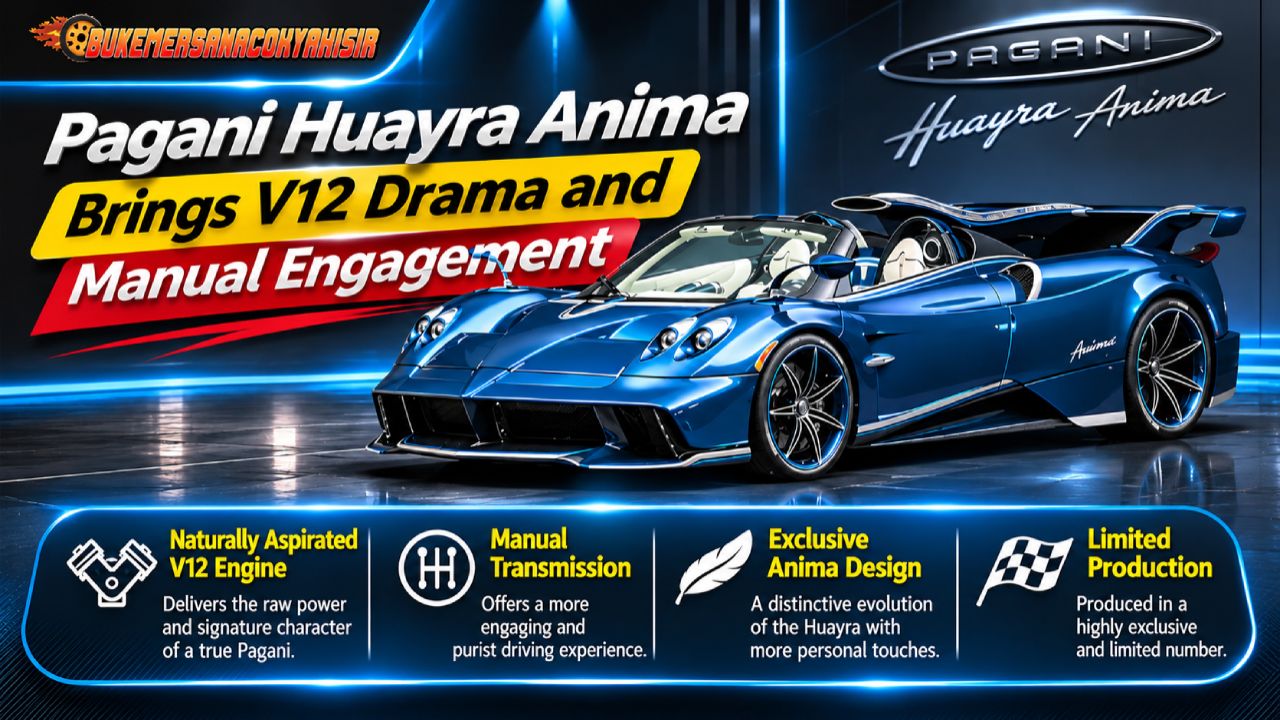
Bukemersanacokyakisir – The Pagani Huayra Anima is the third and final example of the Huayra 70 series. Its name means “soul” in Italian, setting the tone for a car shaped around personal expression. Beneath the bespoke bodywork sits a compelling mechanical combination: a twin-turbocharged V12, rear-wheel drive, and a seven-speed manual gearbox. However, the Anima’s appeal extends beyond its specification. Developed in collaboration with its owner, it represents a particular interpretation of the Huayra rather than a conventional model update. That distinction gives the project its character. This is a hypercar intended to reflect someone’s imagination as clearly as Pagani’s engineering.
A Seven-Speed Manual Shapes the Driving Experience
The manual gearbox is arguably the Anima’s most engaging feature. It gives the driver a direct role in selecting ratios and coordinating each change. Consequently, the conversation moves beyond acceleration figures towards the experience of operating the car. A manual transmission does not automatically make a vehicle better, but it changes the relationship between driver and machine. Here, that choice feels consistent with the Anima’s emphasis on personality. Rear-wheel drive further defines its mechanical layout. Nevertheless, judging shift quality, clutch behaviour, or everyday usability would require driving the finished car. The specification promises involvement; the experience remains something to assess behind the wheel.
Mercedes-AMG V12 Delivers Substantial Performance
Power comes from a 6.0-litre twin-turbocharged Mercedes-AMG V12, with quoted output of 852 bhp. Torque is listed at 811 lb-ft, approximately 1,100 Nm. Those figures place substantial responsibility on the drivetrain and rear tyres. However, they reveal only part of the engine’s character. Throttle response, power delivery, and gearing will influence how accessible that performance feels. In a manual hypercar, those qualities matter because the driver participates more closely in managing the engine. The combination is fascinating on paper, although it would be premature to describe its responsiveness or refinement without a proper road or track evaluation.
Bespoke Bodywork Gives the Anima a Busier Silhouette
The Anima adopts a more elaborate exterior than the familiar Huayra shape. Creases, recesses, and additional aerodynamic elements create a layered appearance. Most noticeably, a large roof scoop leads the eye towards a substantial rear wing. Together, these features give the car a visual connection to endurance-racing machinery. Whether that makes it more attractive is a matter of taste. Some enthusiasts may prefer the cleaner proportions of other Paganis. Others will appreciate the expressive approach of this commission. Either way, the bodywork makes the Anima immediately distinguishable, reinforcing the sense that its owner wanted a personal statement.
Also Read : Helicopters Collide Near Everest, Leaving One Foreign Tourist Dead
Blue Accents Connect the Exterior Details
Colour plays an important role in organising the Anima’s complex surfaces. Shades identified as Azzurro Metallizzato and Blue Inchiostrato appear across the exterior treatment. Blue detailing highlights areas around the headlights, wheels, aerodynamic components, and rear wing. As a result, separate elements gain a shared visual identity. This matters on a design with so many competing shapes. A consistent accent colour can guide the eye and bring cohesion to a busy silhouette. Nevertheless, the treatment remains deliberately expressive. Its success depends less on universal approval than on how convincingly it communicates the personality behind the commission.
Pale Leather Provides Contrast Inside the Cabin
Inside, pale leather introduces a softer counterpoint to the dramatic exterior. Milled aluminium components accompany Pagani’s intricate switches and instrumentation, giving the cabin a distinctly mechanical appearance. Rather than relying on a single visual centrepiece, the interior draws attention through smaller details. Materials, controls, and instrument surrounds become part of the experience. That approach suits a car built around an individual commission. However, craftsmanship and usability are separate considerations. Photographs and specifications can reveal the design intent, while comfort, visibility, and control placement require closer examination. Visually, the contrast between light upholstery and metallic components gives the cabin a distinctive atmosphere.
Familiar Huayra Engineering Supports the New Design
Despite its individual appearance, the Anima retains established Huayra foundations. Its structure uses Pagani’s carbon-titanium and Carbo-Triax construction, accompanied by new carbon-fibre body panels. Adaptive dampers and Brembo brakes complete the main chassis features described. This combination places bespoke design over a familiar engineering base. Importantly, individual bodywork should not be treated as proof of improved handling or braking. Those conclusions require measurements and testing. Instead, the technical package explains how the project remains connected to the broader Huayra family. The Anima’s identity comes from the interaction between those foundations and the owner’s specific design choices.
Top Speed Is Quoted, but Acceleration Remains Unannounced
The stated maximum speed is 217 mph, approximately 349 km/h. However, Pagani has not supplied a 0–62 mph acceleration figure in the details presented. There is therefore little value in inventing one from the power output alone. Traction, gearing, weight, and test conditions would all affect the result. More broadly, the missing sprint time does not diminish the most interesting aspect of the project. The Anima combines extraordinary performance potential with a transmission chosen for participation. Its appeal rests on how those elements work together, rather than on whether one particular acceleration statistic becomes its defining headline.
An Owner’s Childhood Ambition Guides the Commission
According to Pagani designer Lorenzo Kerkoc, the customisation process lasted more than a year. Discussions explored the owner’s personality, memories, and childhood ambition to create a special car with Horacio Pagani. That background helps explain the Anima’s unusually personal design. Each decision belongs to a wider conversation about what the car should represent. For enthusiasts, the result may invite debate over proportions, detailing, and restraint. Yet the project offers a clear example of what bespoke automotive design can achieve: translating an individual brief into a physical machine. The Pagani Huayra Anima makes that relationship central to its identity.

Post Comment