BMW i3 Review: How the Electric 3 Series Balances Range, Comfort and Handling
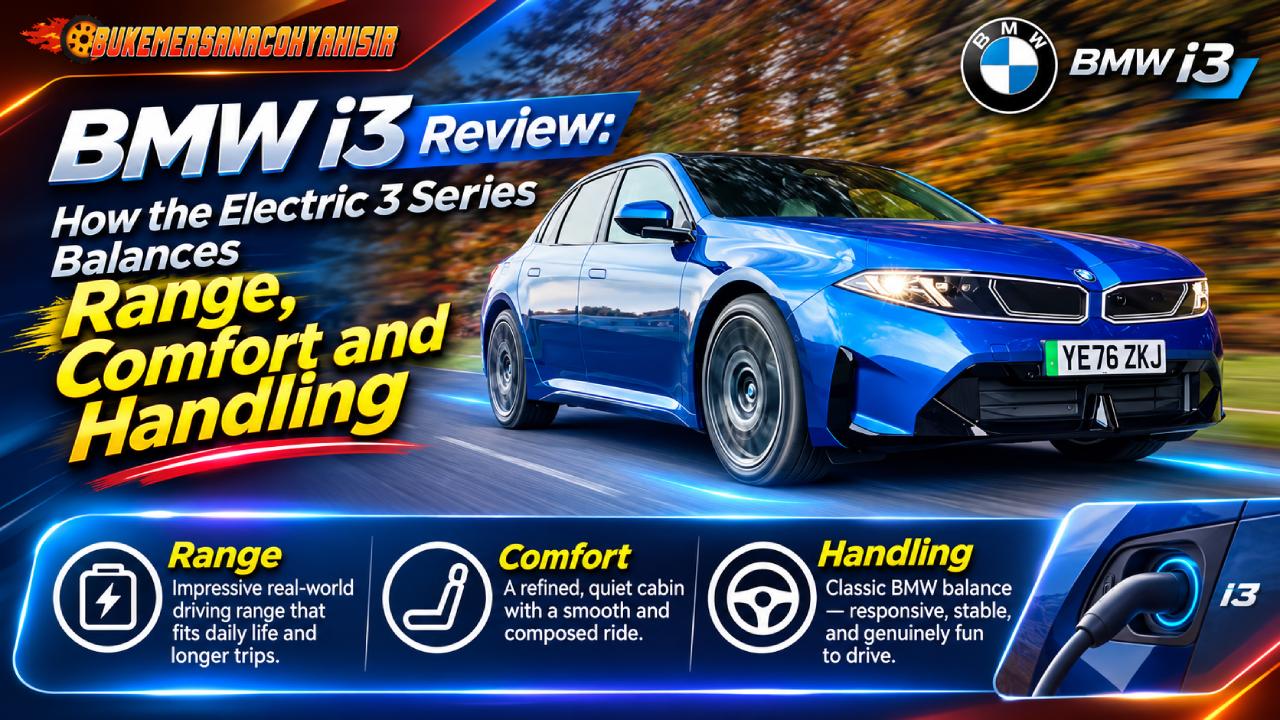
Bukemersanacokyakisir – The new BMW i3 brings fully electric power to the 3 Series saloon formula. It shares its Neue Klasse platform with the iX3 SUV, while BMW continues to offer a separate combustion-powered 3 Series. The headline figure belongs to the i3 50 xDrive, which claims up to 566 miles of WLTP range. Yet the car’s strongest qualities extend beyond battery capacity. Initial driving impressions describe quick responses and a relaxed ride at everyday speeds. Meanwhile, the heavier electric saloon feels less composed when pushed than the petrol M350i xDrive. That trade-off matters because the i3 has to meet two expectations. It needs to make long electric journeys easier while retaining the balance that drivers associate with a BMW saloon.
The 40 xDrive and 50 xDrive Offer Different Priorities
The UK range opens with two dual-motor, all-wheel-drive models. The i3 40 xDrive starts at £47,925 and pairs an 82.8 kWh battery with 368 bhp. BMW quotes up to 441 miles of WLTP range and a 0–62 mph time of 5.4 seconds. Meanwhile, the i3 50 xDrive starts at £53,425, produces 463 bhp and carries a larger 108.7 kWh battery. It reaches 62 mph in 4.7 seconds and raises the claimed range to 566 miles. Both versions have a restricted top speed of 124 mph. For the £5,500 price difference, the 50 xDrive adds 125 miles of rated range and quicker acceleration. The extra range is likely to matter most to drivers who regularly cover long distances.
The 566-Mile Range Claim Needs Real-World Context
The 50 xDrive’s 566-mile figure comes from the WLTP test cycle. It gives buyers a common basis for comparing electric cars, while motorway speed, temperature and driving style can change what they achieve on the road. To put the claim in perspective, achieving three-quarters of the rated figure would mean roughly 425 miles on a charge. That is an illustration rather than a measured result. BMW also quotes efficiency of up to 4.6 miles per kWh for the 50 xDrive, compared with around 4.3 miles per kWh for the 40 xDrive. Since the 50 also has the larger battery, both its quoted efficiency and its capacity help explain the gap between the two models.
The 800-Volt System Makes Short Charging Stops More Useful
BMW says a suitable 400 kW charger can add the equivalent of up to 262 miles in about 10 minutes. At a 150 kW charger, the quoted example is around 100 miles in 15 minutes. These figures describe how much range a brief stop could restore under suitable conditions. Actual results depend on factors such as the charger, the battery’s temperature and its charge level when the car plugs in. For a driver planning a long trip, that makes charging access as relevant as the headline range. The i3 also supports bidirectional charging, including 3.7 kW vehicle-to-load capability. This gives the battery another use when parked, such as powering compatible equipment away from a mains socket.
Neue Klasse Software Coordinates the Battery, Brakes and Steering
The i3 uses BMW’s Heart of Joy control unit to coordinate the drivetrain, braking, steering, charging and energy recovery. Bringing those functions together can help the car respond more consistently when the driver moves from acceleration to slowing down. In traffic, for example, the transition between regenerative braking and conventional braking matters more to the driver than the computing power behind it. The architecture also uses around 600 metres less wiring, while over-the-air updates allow BMW to add or refine supported functions. Meanwhile, the sixth-generation battery places cylindrical cells directly into the pack. The battery housing also forms part of the car’s structure, helping improve rigidity. Together, these choices affect both how the i3 is built and how its systems work on the road.
Also Read : Trump Faces Growing Republican Backlash After Midterm Election Defeat
A Longer Wheelbase Changes the Electric Saloon’s Proportions
The i3 is about 4.76 metres long, just 5 mm longer than the combustion 3 Series. However, its 2,897 mm wheelbase gives it 37 mm more space between the axles. It also has a shorter distance between the front axle and the base of the windscreen, which changes the side profile. Toward the rear, BMW raised the seats to accommodate the battery and its control hardware. The roofline rises accordingly. Up front, horizontal lighting gives the saloon a wider-looking face. In contrast, the rear light treatment can make the tail look taller from some angles. The front and side views show the advantages of the electric proportions most clearly, while the rear reveals where packaging has influenced the shape.
Panoramic Vision Changes How Drivers Read the Dashboard
Inside, BMW’s Panoramic Vision places information on a narrow display across the base of the windscreen. A separate touchscreen handles the central iDrive interface. The layout gives each screen a different purpose. The upper display puts information nearer the driver’s line of sight, while the touchscreen handles interactions that need more space. In practice, the useful comparison is how easily a driver can check a navigation instruction or adjust a setting without losing track of the road. The new steering wheel and cabin materials add to the change in atmosphere. However, the display arrangement is likely to make the bigger difference in daily use, especially for drivers moving from a 3 Series with a more conventional instrument cluster.
Smooth Everyday Responses Give Way to a Heavier Feel at Pace
Initial driving impressions describe the i3 as smooth, responsive and relaxed at ordinary speeds. That combination suits a saloon likely to spend much of its time commuting or covering motorway miles. Increase the pace on a winding road, however, and the suspension has more mass to control. The standard setup uses passive dampers, while adaptive damping is available with selected M Sport configurations. The petrol M350i xDrive still feels slightly more engaging in those quicker moments. For a useful comparison, drive both on the same route. A steady stretch will show how the i3 settles into a cruise, while a series of bends will reveal how each car responds when the driver changes direction and speed.
Post Comment