Volkswagen ID. Polo GTI Clubsport Concept Packs 362 bhp Into a Two-Door EV
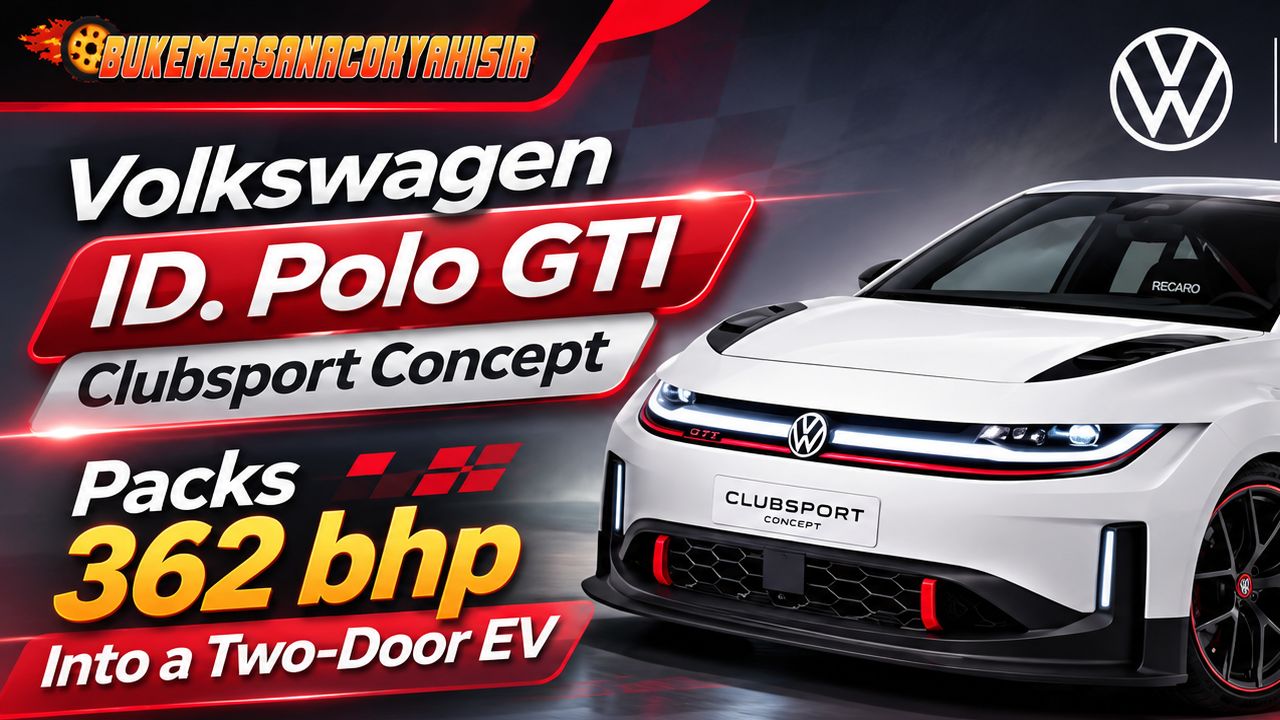
Bukemersanacokyakisir – Volkswagen is celebrating 50 years of GTI with a two-door electric hatchback built for the track. The ID. Polo GTI Clubsport Concept is the first Volkswagen EV to get the full Clubsport treatment. It keeps front-wheel drive and adds a stronger motor, adaptive suspension, and a cabin stripped back to two seats. From the outside, the compact proportions still belong to a Polo. Look through the side window, however, and a roll cage shows how far the engineers have taken the idea. Even before the car moves, the cabin makes its purpose clear. For longtime GTI fans, the interesting question is how that familiar small-car format will feel with more than 360 bhp going through the front wheels. Volkswagen’s changes give some clues about how it intends to make that power usable.
An APP550 Motor Raises Output to 362 bhp
The APP550 motor usually powers larger Volkswagen EVs such as the ID.7 and ID. Tiguan. In the Clubsport, it produces 362 bhp and 406 lb-ft of torque. Compared with the standard ID. Polo GTI’s 223 bhp, that is an increase of 139 bhp, or roughly 62 percent. Fitting the motor into a smaller hatchback changes the role it plays. Here, its output has to work through a front axle that also handles steering. Consequently, Volkswagen had to consider how the car would put down power as it left a corner. That challenge helps explain the addition of an electronic differential lock and adaptive suspension. The larger motor may grab the headline, but the way those systems work together will help determine how much power the driver can use on track.
Volkswagen Quotes 0–62 mph in 4.7 Seconds
Volkswagen quotes a 0–62 mph time of 4.7 seconds and a top speed of 149 mph. Those figures describe the Polo’s straight-line performance, but a circuit gives the driver a wider range of situations to judge. Picture the car leaving a tight corner. As the driver starts to unwind the steering, the front tyres still have to hold their line while transmitting power. How progressively the accelerator responds can make a difference to how confidently the driver builds speed. Meanwhile, quicker corners place a different demand on the chassis because the car has to settle before the next change of direction. Both situations would reveal more about the concept than a timed launch alone. For now, the quoted figures offer a starting point for understanding what the upgraded motor brings.
An Electronic Differential Helps the Front Tyres Find Grip
The Clubsport retains front-wheel drive, so Volkswagen adds an electronic differential lock to help manage traction across the front axle. Adaptive suspension also helps control how the body responds when the driver brakes, turns, or accelerates. Each system addresses a different part of a corner. Under braking, the suspension manages the body’s movement as weight shifts forward. On the way out, the differential helps the front tyres make better use of the available grip. That balance matters because the same tyres have to steer the car and transmit the motor’s torque. A driver will also want the response to feel consistent from one corner to the next. If the setup delivers that predictability, the Clubsport’s extra power should be easier to use across a full lap.
Also Read : Jennifer Lawrence Reveals New Breast Implants and Surprising Personal Details
Ceramic Brakes Match the Demands of Repeated Laps
Volkswagen fits the Clubsport with a ceramic brake system to suit its track-focused brief. One hard stop can show how quickly a car slows. Over several laps, however, a driver can also judge whether the pedal feels consistent as heat builds. A predictable response makes it easier to judge when to brake and how much pressure to apply before turning. That matters in a hatchback which can build speed quickly between corners and then has to shed it again moments later. Volkswagen has shared the type of brake hardware it chose for the concept. A sustained track session would show how it performs under repeated use. Until then, the ceramic system tells us what the engineers prioritised alongside the motor upgrade.
Flared Arches and a Carbon-Fibre Wing Set It Apart
Flared wheel arches give the Clubsport a broader stance, while a large front splitter makes the nose appear lower. At the back, Volkswagen adds a diffuser and a carbon-fibre wing. Together, these changes give the compact hatchback a rally-car profile, especially from the rear. Much of the effect comes from the contrast between the short body and the prominent aerodynamic pieces. Even from a distance, the shape is easy to distinguish from the standard GTI. The hardware also invites a practical question about what it contributes at speed. Its visual impact is clear, while figures or track testing would help establish its aerodynamic effect. For an anniversary concept, the bodywork provides a clear link between the familiar Polo shape and the car Volkswagen has developed for circuit use.
Recaro Seats and a Roll Cage Take Over the Cabin
Volkswagen removes the rear seats and infotainment screens to make room for a more focused cabin. A full roll cage sits behind the two front occupants, who get Recaro bucket seats and five-point harnesses. Open the door and the changes are immediately apparent. The front seats hold the occupants in place, while the space behind them is arranged around the cage. In a standard hatchback, that same area would carry passengers or give the owner more flexibility for luggage. Here, the layout reflects how Volkswagen expects the concept to spend its time. Removing the screens reinforces that purpose and shifts attention towards the driving position. From inside the car, those decisions explain the Clubsport’s character more directly than the exterior styling.
Essen Motor Show Will Give the Public a First Look
Volkswagen plans to present the ID. Polo GTI Clubsport Concept at the Essen Motor Show. The company describes the car as a preview of how the GTI could develop in the electric era. Volkswagen technology chief Kai Grünitz pointed to the MEB+ platform as part of what made the project possible. At the show, visitors will be able to see how the broader bodywork, two-door shape, and stripped cabin fit together. Production plans remain unconfirmed, so the concept’s most immediate role is to show what Volkswagen can do with the electric Polo. For GTI fans, the detail worth watching is which ideas might carry over. The motor provides the headline figure, while the differential and suspension offer clues about how a future electric Clubsport could feel through a corner.


Post Comment