Gunther Werks vs Eccentrica: Two Ways to Rebuild a ’90s Icon
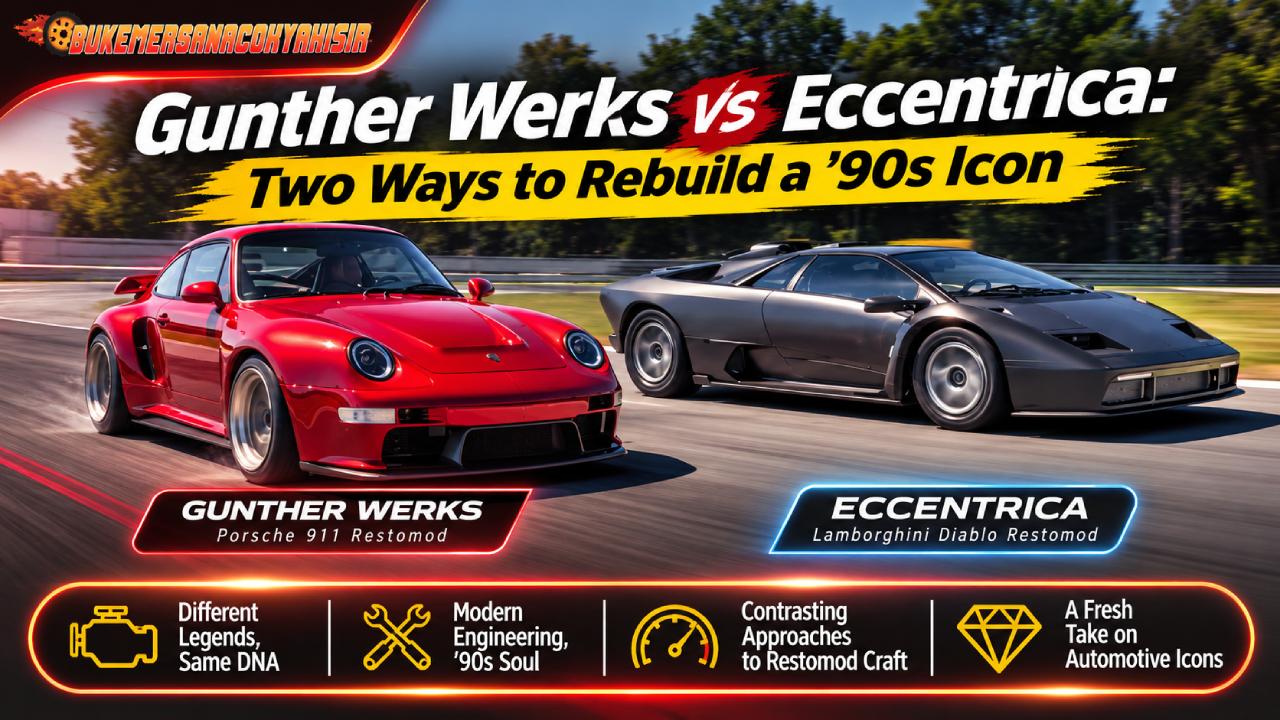
Bukemersanacokyakisir – The Gunther Werks vs Eccentrica comparison starts with two familiar shapes and one difficult question: how much should you change a classic? Gunther Werks starts with a Porsche 993 Carrera and turns it into an 850bhp Turbo. Meanwhile, Eccentrica reworks the Lamborghini Diablo around its original naturally aspirated V12, now producing 550bhp. One car asks what the old 911 could become with a much stiffer structure and far more power. The other asks how much of the Diablo experience can survive a thorough rebuild. That difference matters more than the 300bhp gap. At a standstill, the Lamborghini makes a strong case with its proportions and cabin. Once the cars reach the track, however, the Porsche’s biggest improvements become easier to appreciate.
Carbon Fibre Changes Both Cars in Different Ways
Gunther Werks widens the Porsche’s front and rear tracks, fits carbon fibre bodywork and adds bracing to the chassis. A substantial rear wing completes the look without making the car unrecognisable as a 993. Eccentrica also uses new carbon fibre panels, but its changes make the Diablo shorter and wider than the original. The exposed engine adds another focal point, while the low, wedge-shaped body still does most of the visual work. Of the two, the Eccentrica makes the stronger first impression. Its carbon body highlights an already dramatic silhouette without relying on the engine’s power figure for attention. The Gunther Werks takes a more purposeful approach. Its wider stance hints at a change that matters once the car is moving: there is more to this rebuild than new body panels.
Twin-Turbo Flat-Six Meets Naturally Aspirated V12
The Gunther Werks Turbo uses a 4.0-litre Rothsport twin-turbo flat-six rated at 850bhp. Its soundtrack is as direct as its purpose: a hard mechanical growl under load, followed by a rush of released boost when the driver lifts. By contrast, Eccentrica retains and upgrades the Diablo’s 5.7-litre V12. It produces 550bhp without turbocharging and pairs with a six-speed manual in place of the original five-speed gearbox. The Eccentrica’s deeper exhaust note gives it the edge for sound, particularly if the appeal of a Diablo begins with the engine behind your shoulders. Still, the Porsche’s harsher note suits a car that prioritises response and pace. The better soundtrack depends on taste. The bigger distinction is how each car uses its power once a corner interrupts the straight.
The Diablo Cabin Makes the Stronger Impression
The Gunther Werks cabin keeps the familiar layout of a 993, then adds a carbon fibre dashboard structure, carbon-shell seats and clear instruments. The controls look easy to read, and the cabin still feels recognisably Porsche despite the expensive materials. Eccentrica takes more creative risks. Its dot-matrix displays evoke early handheld games, while the exposed shift gate makes the manual gearbox part of the interior design. Even so, some of the original Diablo’s awkwardness remains. The seats angle inward, and the pedals sit well to the right. That detail captures the trade-off neatly. The Eccentrica feels more distinctive from the driver’s seat, but a cabin can preserve familiar quirks as easily as familiar charm. On design alone, though, the Lamborghini makes the stronger case for spending time inside.
Also Read : Maddie Watson Playfully Teases Mom Jamie Lynn Spears on TikTok
The Gunther Werks Turbo Pulls Ahead on Track
The Porsche’s strongest argument emerges under braking and through corners. In the track comparison, it felt compact and alert, with enough front grip to turn in decisively. The rear could still move as the car settled into a bend, preserving some of the tension that makes an old 911 engaging. However, its braking, grip and balance gave the driver the confidence to work with that movement. This is where the stiffer structure matters more than the headline power figure. Adding 850bhp would be easy to notice on a straight. Making the rest of the car feel ready for that output is the harder task. The firm ride and loud cooling fan remain part of the experience, but the Porsche feels like a complete package when the pace rises.
Eccentrica Preserves the Diablo’s Demanding Character
A lighter clutch, power steering and a more satisfying shift make parts of the Diablo experience easier to enjoy. Nevertheless, the Eccentrica still feels wide and can shudder at low speeds. The test car also showed signs of overheating under hard use, with a noticeable drop in power. That observation applies to the car in the comparison; it does not establish how every example will behave. Still, it matters when judging this particular build. The Eccentrica’s appeal lies in how much of the Diablo survives the conversion, from the driving position to the effort behind each gear change. Yet the same commitment creates a difficult question. If the original car’s less reassuring behaviour remains when the pace builds, has the conversion gone far enough for someone who intends to drive it hard?
What the Two Restomods Cost as Tested
The Gunther Werks Turbo came in at a little over $2 million, compared with approximately $1.7 million for the Eccentrica V12. Both figures accounted for the donor car, conversion work and taxes in this comparison. They describe the featured builds rather than universal prices. Even so, they sharpen the question of value. A Diablo fan might reasonably compare the Eccentrica with an original car that has received a careful restoration and selective upgrades. The Eccentrica answers with bespoke bodywork, a reworked cabin and a revised drivetrain. The Porsche makes its case differently. Its biggest changes are easier to appreciate through the steering, brakes and chassis than in a photograph. For buyers who put track feel first, that difference gives the higher price a clearer rationale.
Which Restomod Is Better to Drive?
The Gunther Werks Turbo wins on driving dynamics. Its advantage comes from the way the chassis, brakes and manual gearbox work together, rather than from its 300bhp lead alone. The Eccentrica still wins on engine sound and makes the more imaginative use of its cabin. It also offers something more specific: a Diablo that retains much of the original car’s personality while making some of its controls easier to live with. That will be enough for buyers who want the wedge, the V12 and the open-gate shift above everything else. For a driver who expects a restomod to change what a classic can do on track, however, the Porsche provides the clearer answer. Its improvements become most apparent in the moments between full-throttle runs: braking, turning and putting power down again.
Post Comment