Volvo XC60 Review: A Calmer SUV With More Electric Range
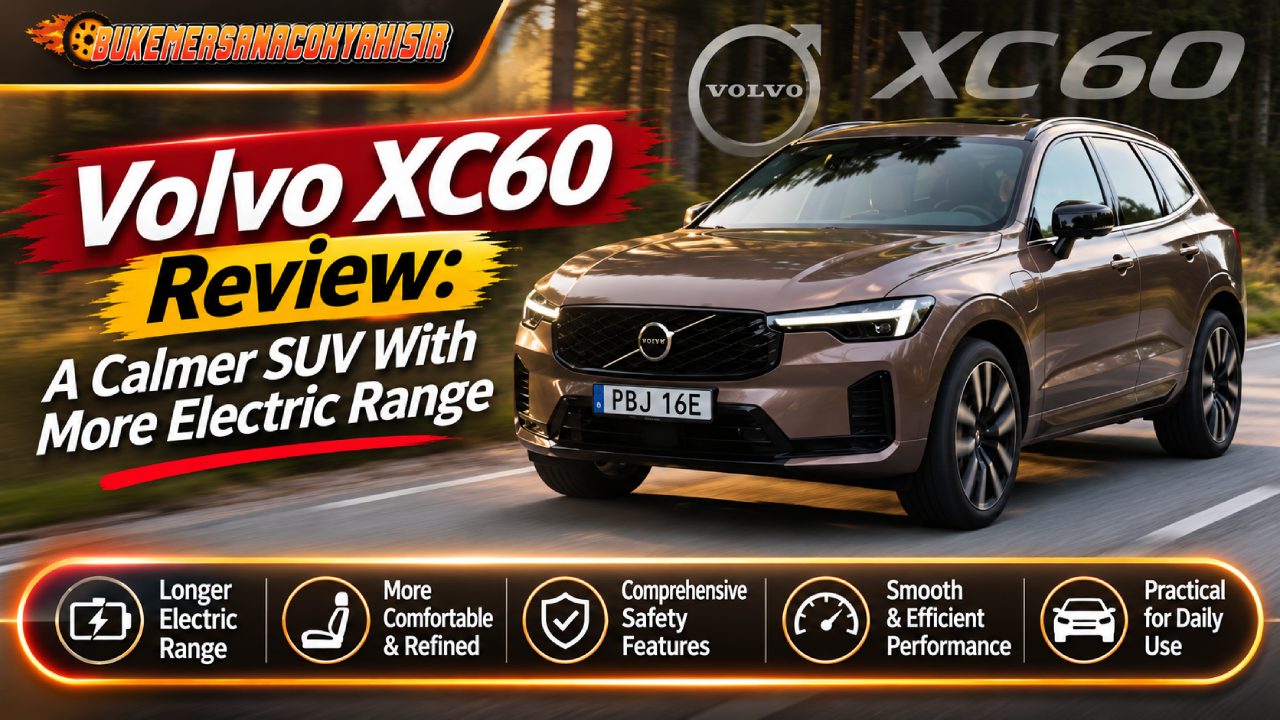
Bukemersanacokyakisir – This Volvo XC60 review focuses on the updated UK model and the choice between a mild hybrid and two long-range plug-in hybrids. The XC60 sits between the compact XC40 and the larger XC90. It gives families five seats and more room to spread out than the XC40, without requiring them to move up to Volvo’s seven-seat SUV. That balance helps explain its appeal. Introduced in 2008, the XC60 has sold more than 2.7 million units and overtook the Volvo 240 in 2025 to become the brand’s best-selling model. Its appeal makes sense on a busy weekday. There’s room for the family, while the cabin still feels like somewhere you can unwind.
A bigger screen brings the cabin up to date
The second-generation XC60 arrived in 2017, and Volvo has refreshed it several times since. The latest update brings a revised grille, fresh lighting details, and a larger infotainment display. Inside, updated materials sit alongside the restrained dashboard design that gives the cabin its character. A lighter interior makes the most of that design, especially on grey days. However, darker upholstery may suit a family that regularly carries muddy boots or sports kit. The bigger screen gives maps and menus more room. During a test drive, it’s worth trying the controls you use often, such as temperature and navigation. How easily you can reach them matters more over time than how sharp the display looks in the showroom.
The B5 keeps ownership simple for drivers who rarely plug in
The B5 uses a 2.0-litre petrol engine with 48-volt mild-hybrid assistance. It produces 247 bhp and reaches 62 mph from rest in 6.9 seconds. That gives it enough performance for motorway slip roads and overtaking with passengers aboard. The mild-hybrid system works in the background, so there’s no charging routine to plan. However, its claimed fuel economy of roughly 32–38 mpg shows the running-cost trade-off of choosing a petrol SUV of this size. At £51,060 in Core trim, it is the least expensive XC60 in the updated UK range. It makes particular sense if you park on the street or regularly travel to places where charging is inconvenient.
Also Read : Kate Middleton Reveals Her Emotional Cancer Journey in Heal
The T6 makes the strongest case for plugging in
The T6 combines 351 bhp with a 0–62 mph time of 5.7 seconds. More useful in daily life is its official electric range of up to 124 miles under the WLTP test cycle. A 35.6 kWh battery gives this version enough capacity to make electric driving a regular part of ownership. Take a 30-mile round-trip commute. With reliable charging, that distance leaves room for errands before the next top-up, depending on conditions. Cold weather, motorway speeds and cabin heating can reduce the miles available from a charge. Even so, the T6’s range gives buyers more flexibility about when to plug in. Its UK starting price is £58,965 in Core trim.
The T8 adds power and comes with higher trims
The T8 raises output to 455 bhp and cuts the 0–62 mph time to 4.8 seconds. It uses the same 35.6 kWh battery as the T6, with an official electric range of up to 117 miles. In the UK, the T8 starts at £69,965 in Ultra trim and is also available as an Ultra Pro. That puts £11,000 between the starting prices of the two plug-in versions. The gap covers a change in equipment as well as performance, so a trim-by-trim comparison matters. For most family journeys, the T6 already has ample power. The T8 makes a clearer case for buyers who want the higher specification and will appreciate its stronger acceleration.
Real-world fuel economy starts with your charging routine
The plug-in XC60 posts three-figure fuel economy in official testing. Those figures reflect a lab cycle in which the car covers part of the journey using stored electricity. Your petrol use will depend heavily on how often you recharge and how much driving you do between charges. For example, someone who plugs in at home and drives short distances may go several days without needing much petrol. A driver who begins long motorway trips with a depleted battery will rely on the engine far more. For a realistic comparison, look at a typical week of driving and work out how many miles you could cover electrically. That gives the official figures a practical context.
A comfort-first alternative to the Q5, X3 and GLC
The Audi Q5, BMW X3 and Mercedes-Benz GLC all compete for much the same buyer. The XC60’s appeal lies in its understated cabin and its emphasis on relaxation. The seats and the simple interior layout matter most when a short school run turns into an hour in traffic. However, comfort is also worth judging on rough urban roads, where the wheel and suspension setup can affect how sharply bumps come through. The same principle applies to family practicality. If child seats or bulky luggage are part of your routine, bring them along when you compare the cars. A few minutes spent loading the boot can tell you more about day-to-day fit than another look at the options list.
Where the XC60 fits alongside the electric EX60
Volvo’s fully electric EX60 becomes a natural comparison if most of your journeys fit comfortably within the T6’s electric range. With home charging and predictable trips, an electric SUV may suit that routine well. The XC60 plug-in hybrid has an advantage for a different pattern. For example, you might cover workdays on battery power, then visit family at weekends along a route where charging is less convenient. In that case, the petrol engine adds flexibility. Within the XC60 range, the T6 offers the longest official electric range and the lowest entry price of the two plug-in models. The B5 remains the straightforward choice for drivers who rarely have somewhere to plug in.


Post Comment