Mazda CX-6e Review: Bold Electric SUV Brings 300-Mile Range
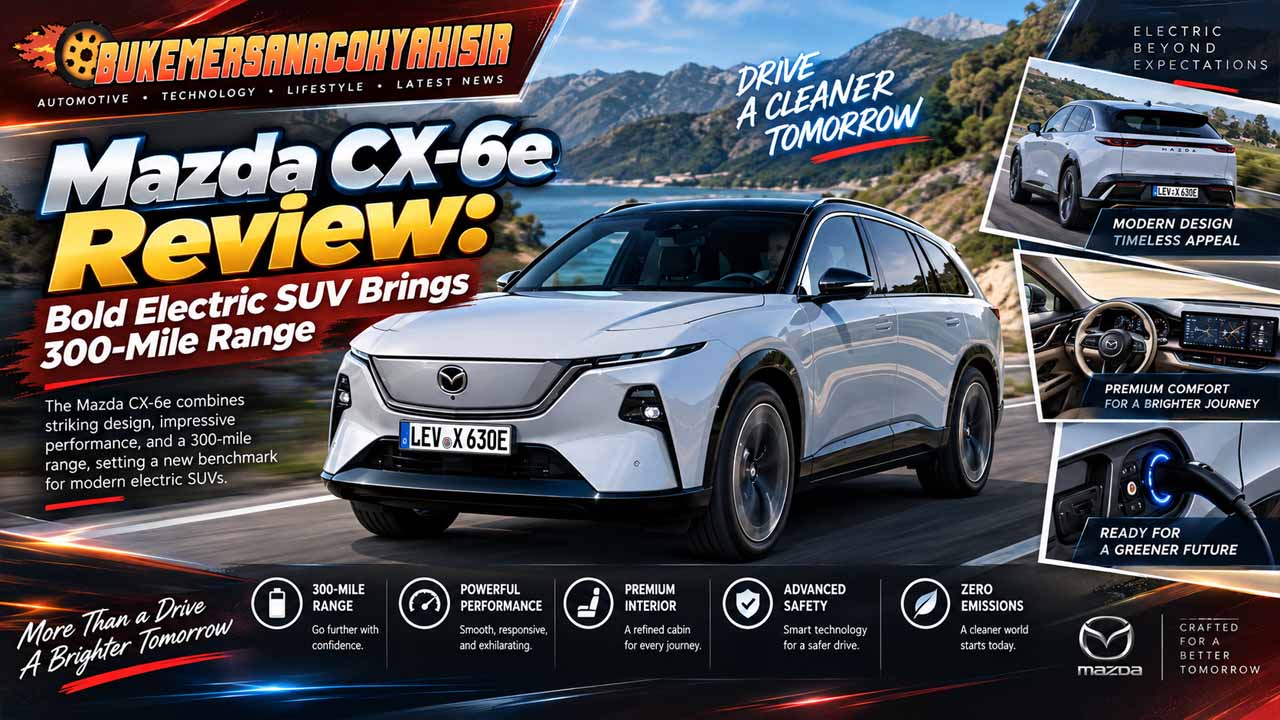
Bukemersanacokyakisir – This Mazda CX-6e review starts with a surprise. The electric SUV feels noticeably different from the traditional Mazda formula. It follows the Mazda 6e saloon but takes a bolder approach to design and technology. At 4.8 metres long and 1.9 metres wide, the CX-6e is a substantial vehicle. However, clever proportions prevent it from appearing excessively bulky. Its sculpted body also incorporates several aerodynamic details. Air passes through a duct near the front bonnet before being directed around the body. Meanwhile, channels near the rear pillars help manage airflow. Mazda offers familiar Soul Red alongside a distinctive deep purple and more conventional shades. As a result, the CX-6e makes a strong visual statement. In my view, that personality matters because electric SUVs now occupy an increasingly crowded market. A distinctive design gives Mazda an immediate way to separate itself from more conservative alternatives.
Shared Architecture Connects the CX-6e with Changan
Underneath its distinctive body sits architecture shared with the Mazda 6e. The platform is connected to Changan, while production takes place in China. That background helps explain why the CX-6e feels different from traditional Mazda products. Still, Mazda Europe has worked on adapting the vehicle for European customers. The engineering team has retuned areas such as steering and overall driving behaviour. Therefore, the CX-6e should not simply be viewed as another model wearing a Mazda badge. It combines shared electric architecture with Mazda-specific development. The relationship is especially visible when comparing it with the Changan Deepal S07, which shares underlying hardware. Yet Mazda gives its SUV a noticeably different cabin and exterior identity. In my view, this collaboration reflects a broader shift across the automotive industry. Developing dedicated EV platforms requires huge investment. Partnerships can reduce those costs while allowing manufacturers to focus resources on design, tuning, and customer experience.
255bhp Motor Delivers Rear-Wheel Drive Performance
The CX-6e keeps its powertrain relatively simple. It uses a permanent magnet synchronous electric motor producing 255bhp. Power is delivered through the rear wheels, giving the SUV a layout that should appeal to drivers familiar with Mazda’s traditional emphasis on balanced handling. Acceleration from 0-62mph takes roughly eight seconds. That figure is respectable rather than spectacular by modern electric-car standards. Several rivals offer considerably more straight-line performance. However, outright acceleration does not appear to be the main objective. Mazda instead prioritises predictable power delivery and comfortable everyday driving. The quoted top speed is 115mph. During the source review, the vehicle was repeatedly driven on unrestricted sections of German Autobahn while testing that figure. In my view, the modest acceleration may actually suit the CX-6e’s character. This is designed primarily as a spacious electric crossover rather than a high-performance EV.
78kWh Battery Provides Up to 300 Miles of Range
A 78kWh battery supports the electric motor. Mazda quotes a WLTP combined driving range of around 300 miles, or roughly 483 kilometres. That number does not place the CX-6e at the top of the electric SUV segment. Nevertheless, it should provide useful flexibility for everyday commuting and longer motorway journeys. Official efficiency is quoted at approximately 3.2 to 3.3 miles per kWh. Interestingly, the source review achieved around 3.7 miles per kWh despite repeated high-speed Autobahn driving. Real-world results will naturally change with temperature, speed, traffic, and driving style. Therefore, one test cannot guarantee the same efficiency for every owner. Still, the result suggests that the aerodynamic work may provide practical benefits. In my view, efficiency matters just as much as battery capacity. A well-managed battery can deliver useful range without forcing the manufacturer to install an unnecessarily large and heavy pack.
Also Read : Lady Gaga Welcomes First Baby With Fiancé Michael Polansky
200kW DC Charging Keeps Longer Trips Practical
Maximum DC charging power reaches 200kW. Again, the figure is useful without setting a new class benchmark. However, peak charging speed only tells part of the story with an electric vehicle. Charging curves, battery temperature, charger capability, and state of charge also influence the time spent at a station. For buyers, the 200kW capability should therefore be considered alongside everyday charging habits. Drivers who mostly recharge at home may rarely need the maximum figure. Meanwhile, frequent motorway travellers could value faster public charging much more. The 300-mile WLTP range also reduces the need to stop excessively often. In my view, Mazda appears to have chosen a balanced specification rather than chasing headline numbers. The CX-6e does not promise record-breaking range or charging performance. Instead, it offers figures that should make long-distance electric driving reasonably convenient.
A Massive 26-Inch Screen Dominates the Interior
Step inside and traditional Mazda design takes another unexpected turn. A huge 26-inch landscape display stretches across much of the dashboard. Part of the screen is dedicated to passenger interaction, creating a cabin that feels strongly technology-led. More importantly, there is no conventional instrument display directly in front of the driver. Mazda instead relies on a sharp head-up display for essential driving information. Climate settings, driving modes, regenerative braking controls, and various assistance-system menus live within the main touchscreen. Consequently, owners will need to become comfortable navigating digital menus. This approach may appeal to drivers who enjoy minimalist interiors. Others may miss physical controls for frequently used functions. In my view, the screen is visually impressive, but usability matters more than sheer size. A 26-inch display only becomes an advantage when important functions remain quick and intuitive to access while driving.
Driver Assistance Systems Can Feel Overly Intrusive
Technology is not universally successful inside the CX-6e. According to the source review, some active safety systems remain more intrusive than desired. Mazda Europe has spent considerable time retuning the Chinese-market EZ-60 for its European transformation into the CX-6e. However, the assistance systems can still demand attention from the driver. Many controls for these features are buried within touchscreen menus. Therefore, drivers who prefer less intervention may find themselves navigating several settings. Modern ADAS technology can provide valuable support, particularly during long journeys. Yet calibration plays a crucial role in whether those systems feel helpful or irritating. In my view, the best driver assistance operates quietly until it is genuinely needed. If owners regularly feel compelled to disable a feature, its implementation deserves further refinement.
Rear-Wheel Drive Gives the CX-6e Friendly Balance
The Mazda CX-6e review does not describe an electric SUV built primarily for enthusiastic driving. Nevertheless, its fundamentals remain interesting. The rear-wheel-drive layout combines with a claimed 47:53 weight distribution. This setup gives the vehicle predictable and friendly balance. Mazda’s European engineering work is particularly noticeable in the steering. The retuned steering rack provides a more natural response and helps make the large SUV easier to position. Consequently, the CX-6e can tackle an interesting road without feeling cumbersome. It also remains easy to guide through everyday traffic. Still, buyers expecting an electric equivalent of the MX-5 philosophy may be disappointed. In my view, that comparison would be unfair. The CX-6e is larger, heavier, and designed for a different purpose. Its achievement lies in making a sizeable electric crossover feel manageable rather than turning it into a sports car.
Camera Mirrors Are Clever but Not Necessarily Better
The range-topping Takumi Plus replaces conventional side mirrors with external cameras. Even the traditional rear-view mirror is swapped for a camera feed. The system contributes to the CX-6e’s futuristic character and may also support aerodynamic efficiency. However, the source review found the side-camera arrangement frustrating in everyday use. Digital mirrors require drivers to change deeply established visual habits. Depth perception and screen placement can also affect how natural they feel. Furthermore, the external cameras remain exposed components on the sides of the vehicle. Buyers who prefer conventional mirrors may therefore find the standard Takumi more appealing. In my view, this is a good example of technology not automatically producing a better experience. Camera mirrors offer aerodynamic benefits, but traditional glass remains remarkably intuitive. Fortunately, buyers do not need to choose the Takumi Plus simply to access the CX-6e’s core strengths.
Cabin Refinement Impresses at Motorway Speeds
One area where the CX-6e performs strongly is refinement. Electric vehicles naturally remove combustion-engine noise, but that silence can expose tyre roar and wind noise. The Mazda reportedly avoids that problem effectively. Even during high-speed Autobahn driving, the cabin remained impressively quiet. Aerodynamic details and the smooth exterior shape likely contribute to this behaviour. The result suits the CX-6e’s long-distance character. A quiet cabin reduces fatigue and makes conversation easier, especially on motorway journeys. It also complements the smooth electric powertrain. In my view, refinement may prove more valuable to owners than dramatic acceleration figures. Drivers experience cabin noise during every journey, whereas maximum performance is used far less frequently. Mazda appears to understand that distinction.
Rear Passengers Get Plenty of Space
Large exterior dimensions translate into generous passenger accommodation. The CX-6e uses a 2.9-metre wheelbase, matching the Mazda 6e saloon. That foundation creates a spacious rear seating area capable of accommodating tall adults comfortably. Higher specifications also add heated rear seats. Consequently, the SUV works well as more than a driver-focused vehicle. Families and passengers should benefit from the additional room. This matters because electric-car platforms can use their packaging advantages to maximise cabin space. Without a conventional engine and transmission layout, designers have greater freedom when distributing interior volume. In my view, Mazda has used the CX-6e’s dimensions sensibly. The vehicle is physically large, but owners receive meaningful cabin space in return.
Takumi Starts Below £43,000 with Plenty of Equipment
Pricing gives the CX-6e another significant advantage. The entry-level Takumi starts just below £43,000 in the UK according to the supplied review. Despite being the base model, its standard equipment is generous. Buyers receive 19-inch wheels, a large panoramic glass roof, the head-up display, and multiple cameras designed to make parking easier. Larger 21-inch wheels cost an additional £1,000. Meanwhile, the Takumi Plus costs slightly more than £45,000. It includes the larger wheels as standard and adds a striking two-tone purple and white interior. Camera-based side and rear-view mirrors are also included. In my view, the regular Takumi may offer the stronger balance. It retains the essential comfort and technology while avoiding the potentially distracting digital mirror setup.
Mazda Targets Some Serious Electric SUV Rivals
Competition will be intense. The CX-6e enters a market containing vehicles such as the Polestar 2, Kia EV6, Skoda Enyaq, Audi Q6 e-tron, and BMW iX3. These alternatives approach electric mobility differently. Some prioritise performance, while others focus on efficiency, premium materials, or practicality. Mazda therefore needs more than competitive specifications. Its distinctive styling, spacious interior, quiet motorway behaviour, and attractive pricing become important differentiators. The CX-6e is unlikely to dominate every comparison based purely on numbers. Its 300-mile range and eight-second 0-62mph time demonstrate that clearly. However, buyers rarely choose cars from spreadsheets alone. In my view, Mazda’s strongest argument is the overall package. It delivers premium-car presence without moving directly into premium-brand pricing.
Mazda CX-6e Review Shows Value Matters More Than Records
Ultimately, this Mazda CX-6e review reveals an electric SUV that does not chase class-leading numbers. Its 255bhp motor, 78kWh battery, 300-mile WLTP range, and 200kW DC charging capability are competitive rather than revolutionary. Instead, Mazda concentrates on distinctive styling, interior space, refinement, and value. The enormous 26-inch touchscreen makes the cabin memorable, although greater reliance on digital controls will divide opinion. Likewise, camera mirrors on the Takumi Plus feel more experimental than essential. On the road, rear-wheel drive and well-judged steering create friendly handling without turning the SUV into an oversized sports car. Perhaps that is the best way to understand the CX-6e. It is not an electric MX-5, nor does it need to be. In my view, its appeal comes from offering a bold and comfortable alternative to familiar electric crossovers at a competitive price.


Post Comment