Toyota Tundra TRD Pro Review: Hybrid Power Meets Serious Off-Road Muscle
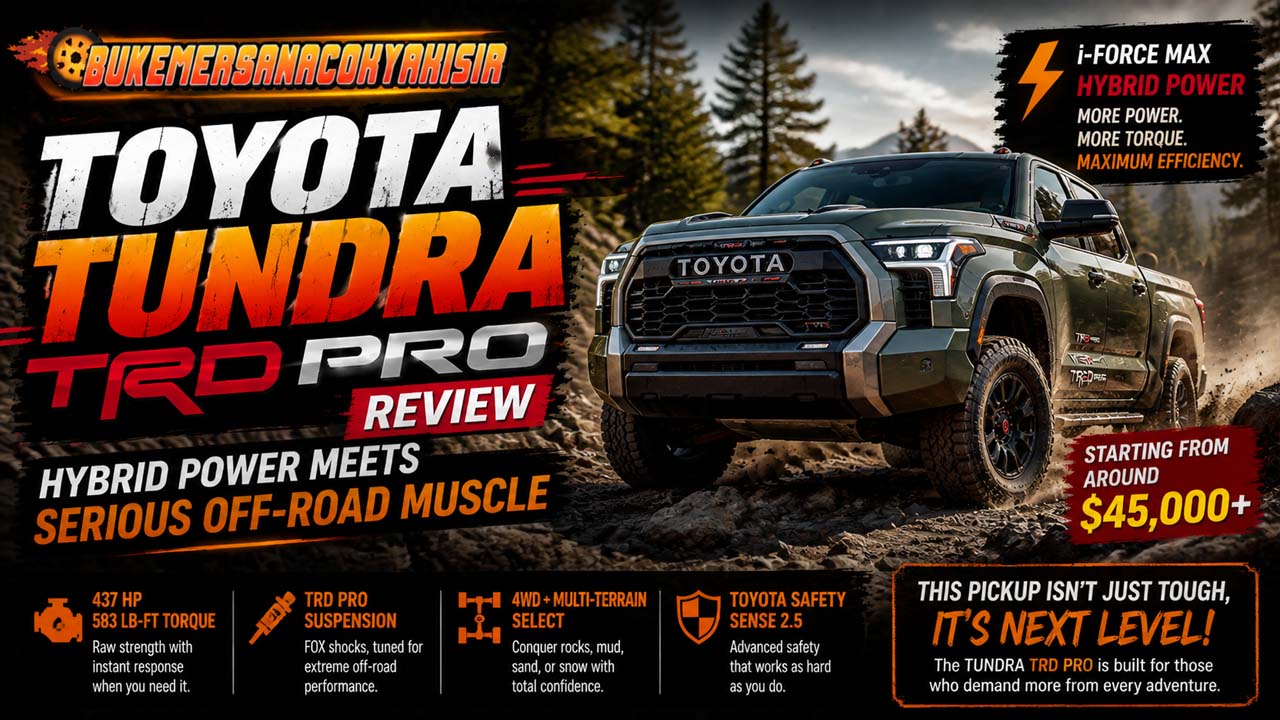
Bukemersanacokyakisir – The Toyota Tundra TRD Pro has never been designed to disappear quietly into traffic. However, the latest version takes that attitude even further. Its striking Honeycomb paint gives the full-size pickup an almost golden appearance, immediately separating it from ordinary work trucks. Yet the dramatic finish is only part of the story. Toyota has equipped this Tundra with serious hardware for drivers who want to explore beyond paved roads. Updated Fox shocks work with a double-wishbone front suspension and a multi-link rear setup. Together, they help the large truck absorb rough terrain without losing its composure. Meanwhile, Toyota has redesigned the front fascia to create a stronger family resemblance with its other adventure-focused vehicles. New front tow hooks add another functional touch. Therefore, although the paint may grab attention first, the engineering underneath gives this TRD Pro its real identity.
Honeycomb Paint Gives the Tundra Extra Personality
Few full-size trucks can wear a bold finish without looking excessive. Fortunately, the Tundra has enough visual presence to make Honeycomb work. The color replaces the more playful Wave Maker teal associated with the previous version. As a result, the truck looks more premium while retaining its adventurous character. Still, Toyota understands that TRD Pro buyers expect much more than a special paint option. The exterior design supports a collection of mechanical upgrades developed for demanding terrain. Its wide stance, muscular body, and off-road equipment create an appearance that feels purposeful rather than decorative. Moreover, the updated front design makes the Tundra look more consistent with Toyota’s broader family of rugged vehicles. In my view, this balance matters. A premium off-road pickup should look special in a parking lot, but its appearance needs to be backed by real capability. Here, the Honeycomb finish simply highlights a machine already designed to attract attention.
Hybrid V6 Delivers 437 HP and Massive Torque
Under the hood, the Toyota Tundra TRD Pro uses Toyota’s 3.4-liter twin-turbocharged i-Force Max V6 hybrid powertrain. It produces 437 hp and 583 lb-ft of torque. Consequently, there is plenty of muscle available for steep climbs, sandy trails, and quick runs across open terrain. A 10-speed automatic transmission manages the power, while the drivetrain can send output to two or all four wheels depending on the selected configuration. However, this Toyota approaches performance differently from some of its louder rivals. Instead of relying heavily on engine theatrics, it emphasizes useful torque and greater efficiency. The reviewed truck returns a claimed combined figure of around 20 mpg. By comparison, the Ram TRX was rated at roughly 12 mpg in the original review. Therefore, the hybrid system brings a meaningful advantage for drivers who also use their truck regularly. It may sound less dramatic, but its performance remains substantial.
Also Read : Apple Eyes China’s CXMT for Memory Chips, but U.S. Rules Complicate the Plan
Fox Suspension Is the Real TRD Pro Secret Weapon
A powerful engine alone cannot transform a heavy pickup into a convincing off-road machine. Therefore, the suspension is arguably one of the most important elements of this Tundra. Updated Fox shocks help the truck handle repeated impacts while traveling quickly across rough surfaces. The system works alongside its substantial front and rear suspension architecture. As a result, bumps that could unsettle a conventional vehicle often feel surprisingly controlled from inside the cabin. The Tundra remains a large and heavy machine, so physics never completely disappears. Nevertheless, its suspension manages that mass remarkably well. Even when driven across terrain resembling a dirt-bike course, the truck can maintain impressive stability. Jumps, deep undulations, and fast sections reveal how much engineering sits beneath the rugged body. It does not suddenly feel like a lightweight rally car. Instead, it delivers something arguably more appropriate for its mission: confidence. That characteristic encourages drivers to explore its capabilities without constantly fighting the vehicle.
Multi-Terrain Select Adds Confidence Away From Asphalt
Modern off-road performance increasingly depends on software as well as mechanical strength. The Toyota Tundra TRD Pro reflects that development through its Multi-Terrain Select system. Drivers can choose settings designed for surfaces such as mud, rocks, and sand. Meanwhile, an automatic mode allows the truck to manage certain decisions itself. Traditional high-range and low-range modes are also available for more demanding situations. Therefore, drivers have several tools for adapting the truck to changing terrain. These systems are especially useful because the Tundra’s size and weight can make mistakes costly when grip disappears. A poorly judged input on soft sand can quickly become an uncomfortable situation in a full-size pickup. However, the electronic assistance works with the four-wheel-drive hardware to help maintain traction. Importantly, the controls are designed to remain accessible rather than intimidating. That approach makes the Tundra easier to explore for drivers who may not have extensive experience with serious off-road vehicles.
Stable and Capable Rather Than Wild and Playful
Push the Tundra harder and its personality becomes clearer. This is not necessarily the most playful performance pickup on the market. Instead, it feels planted, predictable, and exceptionally solid. Its substantial weight becomes noticeable during acceleration and rapid direction changes. Nevertheless, once the truck builds momentum, the suspension does an impressive job of controlling body movement. Over rough surfaces, the Tundra often seems to flatten out obstacles before they reach the driver. Consequently, you sometimes feel like a passenger watching the chassis solve problems underneath you. Braking performance is equally important on a vehicle this heavy. Dual-piston front brakes and single-piston rear units provide the stopping power needed after demanding sections. They reportedly continued performing well despite considerable punishment during testing. Therefore, the TRD Pro experience is less about dramatic movements and more about dependable control. Some rivals may provide more excitement, but the Toyota’s predictable behavior has its own appeal.
Falken Wildpeak Tires Keep It Usable on the Highway
Off-road modifications often introduce significant compromises on normal roads. However, the Toyota Tundra TRD Pro remains surprisingly manageable when the adventure ends. Its 33-inch Falken Wildpeak tires offer meaningful off-road traction without becoming excessively aggressive on pavement. As a result, moving between highway driving and dirt trails feels relatively seamless. Of course, the Tundra cannot hide its dimensions. It is tall, wide, heavy, and unmistakably a full-size pickup. Yet the steering remains direct enough to prevent the truck from feeling unnecessarily difficult to place. Meanwhile, the heavy-duty suspension absorbs many road imperfections before they disturb passengers. Most of the expensive TRD equipment will naturally remain underused during ordinary commuting. Still, that does not make the Tundra unpleasant on paved roads. Instead, it gives owners the flexibility to use one vehicle for daily journeys and weekend adventures. That versatility could be more valuable than extreme performance figures for many buyers.
CrewMax Cabin Blends Practicality With Modern Technology
Inside, the Tundra offers far more than the bare essentials expected from traditional work trucks. The CrewMax configuration provides comfortable seating for four adults, while a fifth passenger can fit when necessary. Storage compartments are spread throughout the substantial cabin. Moreover, the dashboard combines physical controls with a large 14-inch touchscreen. Wireless Apple CarPlay and Android Auto compatibility bring familiar smartphone connectivity into the truck. However, the screen also becomes an important tool when the road disappears. A Multi-Terrain Monitor uses exterior cameras to improve visibility around the vehicle. This can be especially helpful when rocks or obstacles sit below the driver’s natural sightline. In a truck this large, that additional perspective can make difficult trails easier to navigate. TRD branding adds some sporting character without completely overwhelming the cabin. Overall, the interior successfully balances technology, practicality, and ruggedness. It feels prepared for long-distance travel while still supporting serious outdoor use.
The 5.5-Foot Bed Keeps the Tundra Practical
Despite all the TRD equipment, Toyota has not forgotten why people buy pickup trucks. Behind the CrewMax cabin sits a 5.5-foot bed that can carry equipment for work or recreation. The power tailgate makes loading easier, while a hands-free knee-lift function provides additional convenience. Final specifications for the newest version were still pending in the original review. However, the previous model offered a maximum payload capacity of around 1,600 pounds. That gives owners enough flexibility to transport substantial gear. For example, a dirt bike and associated equipment should fit naturally into the Tundra’s adventurous lifestyle. Toyota also provides towing technology that can recognize a connected trailer. The system then integrates relevant information into the truck’s onboard electronics to improve control. Therefore, the TRD Pro remains useful even when it is not flying across dunes. Its ability to combine recreation with traditional pickup duties is one of its most convincing strengths.
Toyota Ruggedness Remains at the Heart of the Experience
Perhaps the most convincing quality of the Toyota Tundra TRD Pro is how solid it feels after being pushed hard. During testing, the truck reportedly handled repeated punishment without developing concerning noises or obvious structural complaints. Long-term durability cannot be judged from a short drive, of course. Nevertheless, the initial impression aligns with Toyota’s long-standing reputation for producing rugged trucks. This matters because performance pickups often face unusually demanding lives. Owners may tow trailers during the week before spending weekends on rocky trails or sandy terrain. Consequently, durability can be more valuable than outright speed. The Tundra’s approach seems built around that idea. It may lack the outrageous soundtrack associated with certain supercharged rivals. Likewise, its heavy personality means it does not always feel eager to play. However, that same substantial construction contributes to the sense that the vehicle can absorb serious abuse and continue moving forward.
Tundra TRD Pro Prioritizes Capability Over Theatre
Ultimately, the Toyota Tundra TRD Pro offers a different interpretation of the high-performance off-road pickup. Its 437 hp hybrid system provides substantial power, while Fox suspension gives it genuine ability across demanding terrain. Meanwhile, the CrewMax cabin and 5.5-foot bed preserve the practicality expected from a full-size truck. It may not deliver the theatrical personality of the Ram TRX or the sport-truck character associated with the Ford Raptor R. However, Toyota appears more interested in creating a stable and dependable adventure platform. The Honeycomb finish adds visual drama, but the real value lies underneath. Pricing had not been finalized in the source review, although expectations placed it around the US$73,000 region. At that level, buyers have several compelling alternatives. Still, drivers who value Toyota toughness, hybrid efficiency, and serious off-road hardware may find the Tundra TRD Pro offers a distinctive combination that its louder rivals cannot quite replicate.


Post Comment