Marc Philip Gemballa Marsien GT Brings 830HP Porsche 959 Spirit to the 2020s
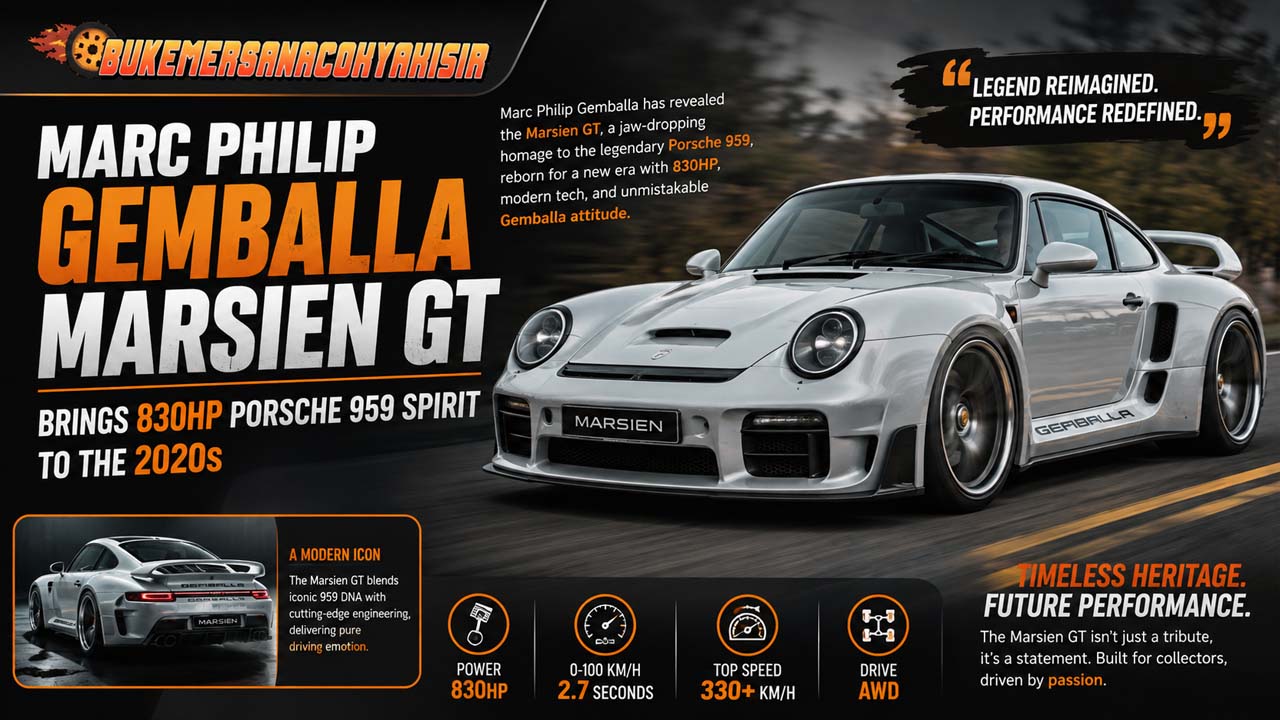
Bukemersanacokyakisir – The modern Porsche lineup currently lacks a true successor to the 918 Spyder. That gap has created room for independent specialists to imagine their own interpretation of a Porsche-based supercar. Kalmar has the 9X9, Tuthill created the GT-One, RML developed the GTH, and Singer continues to push the 911 formula in new directions. Now, the Marc Philip Gemballa Marsien GT joins that exclusive group. This road-focused machine evolves from the off-road Marsien project but moves in a completely different direction. Instead of simply lowering the suspension and fitting road tyres, Marc Philip Gemballa has extensively reworked the body, aerodynamics, cabin, and chassis. The result is a highly modified 992.1 Turbo-based supercar with 830 horsepower, rear-biased drama, and clear inspiration from the Porsche 959. More importantly, the Marsien GT aims to remain usable on the road rather than becoming another track-focused special.
The Marsien GT Is More Than a Lowered Marsien
The easiest route would have been to take the original Marsien and make a few basic road-focused changes. Marc Philip Gemballa chose a far more ambitious approach. According to the company, only the doors and roof are shared between the two versions. Everything else has been substantially redesigned. The roof now carries a large scoop that feeds the intercooler system. Meanwhile, the carbon-fibre body features a central bonnet fuel filler and more aggressive front intakes. The side profile has also been reworked, while the rear gains a far more dramatic diffuser. These changes give the Marc Philip Gemballa Marsien GT a lower and sharper visual identity. Instead of looking like an off-road supercar converted for tarmac, it feels like a separate project built around the same core idea.
Carbon Bodywork Gives the GT a More Serious Presence
The GT uses extensive carbon-fibre bodywork to create a wider and more dramatic shape. Its front end takes inspiration from high-performance 911 models, especially the GT2 RS. The square-jawed intakes give the car a far more aggressive appearance. Along the sides, the body has been reshaped to improve both visual balance and airflow. At the rear, the oversized diffuser and signature wing create a clear connection to the Porsche 959. However, the design does not simply copy the past. Instead, it blends retro supercar proportions with modern carbon construction. New wheels and tyres complete the transformation. The overall result feels purposeful without becoming excessively track-focused. That balance is important because the GT is meant to function as a high-performance road car rather than a lap-time machine.
RUF-Tuned Flat-Six Produces 830 Horsepower as Standard
Power comes from a RUF-tuned twin-turbo flat-six engine. On the original Marsien, buyers could choose between 750 horsepower and an upgraded 830-horsepower setup. Interestingly, every customer reportedly selected the higher-output version. Because of that, the Marsien GT now comes with 830 horsepower as standard. That already puts the car deep into supercar territory. Even more extreme versions are being developed, with output expected to exceed 900 horsepower. Marc Philip Gemballa claims the GT can accelerate from 0 to 62 mph in just 2.4 seconds. Top speed is quoted at 205 mph. Those figures place it firmly among the fastest road-going Porsche-based creations available today. However, the company is not chasing dramatic Nürburgring claims. The focus remains on usable performance rather than outright circuit dominance.
A New Akrapovic Exhaust Adds More Character
The road-focused GT also receives a new quad-exhaust system developed by Akrapovic. This replaces the twin-pipe arrangement used on the off-road Marsien. The upgrade is not merely cosmetic. A high-performance exhaust system can influence throttle response, engine breathing, and the overall character of the car. More importantly, it gives the GT a distinct identity compared with the original project. Four exhaust outlets also reinforce the car’s road-supercar appearance. Combined with the RUF-tuned engine, the setup should give the Marsien GT a more dramatic soundtrack. In a market where many modern performance cars are becoming quieter or electrified, that mechanical character may be one of its strongest emotional selling points.
Baca Juga : Singapore Host Thailand at Jalan Besar in ASEAN Championship Semifinal
The Donor Car Is a 992.1 Porsche 911 Turbo
The Marsien GT begins life as a Porsche 992.1 Turbo donor car. A Turbo S is preferred, and the donor must be a coupe. Interestingly, Marc Philip Gemballa avoids using the newest Turbo S generation with its more complicated hybridised turbo technology. This decision gives the GT access to some interior features that enthusiasts still appreciate. The older donor retains a physical rev counter and a traditional twist-style engine starter. Those details may sound minor, but they matter in a car designed around driver engagement. The 992.1 platform also provides proven all-wheel-drive performance, a strong chassis, and a highly developed dual-clutch transmission. From there, the Marsien GT transforms the donor into something far more exclusive.
Active Aerodynamics Add a Dramatic Party Trick
The steering wheel drive-mode selector controls more than just powertrain settings. Turning it can activate aerodynamic elements at the front and rear. Flaps rise from the front wing, while the main spoiler changes position. The effect is visually dramatic and gives the GT a sense of mechanical theatre. It has been compared to the aggressive aerodynamic modes found on extreme hypercars such as the Mercedes-AMG One. However, the Marsien GT is not positioned as a pure track weapon. The aero system instead adds performance functionality without dominating the character of the car. For owners, it also delivers one of those details that makes an already rare vehicle feel even more special.
The Interior Mixes Carrera GT Inspiration with Modern 911 Hardware
The cabin receives several changes designed to make it feel more special than a standard 911 Turbo. One of the most noticeable elements is the centre console. It sits at a steeper angle than the standard Porsche layout, referencing the bridge-like consoles used in the Carrera GT and 918 Spyder. The PDK gear selector has also been replaced with a manual-style lever. Visually, it resembles the shifter found in the Carrera GT. This does not turn the transmission into a manual, but it creates a more emotional interaction. Marc Philip Gemballa also adds more suede around the cabin. In doing so, the company reduces the amount of glossy piano-black plastic found in the standard car. Even the pop-out door handles are removed, creating a cleaner and more traditional feel.
Road Usability Matters More Than Lap-Time Records
One of the most interesting things about the Marsien GT is what it does not try to be. There is no major downforce claim and no headline Nürburgring target. Instead, the car is designed as a usable high-performance road machine. That philosophy feels refreshing in a market full of track-focused specials. The suspension is completely bespoke and lower than the off-road Marsien setup. However, it still includes a 100 mm front nose-lift system. That makes the car easier to use around ramps, driveways, and speed bumps. The focus on road usability also matches the Porsche 959 inspiration. The original 959 was not simply about outright speed. It combined innovation, performance, and real-world usability. The Marsien GT follows a similar philosophy in a much more modern and extreme form.
Price Places the Marsien GT in Hypercar Territory
Exclusivity comes at a very high price. The GT conversion alone costs €770,000 before taxes. Buyers also need to provide a donor car and pay for additional options. A suitable used 992 Turbo S coupe can cost around £120,000 depending on specification and market conditions. On the previous Marsien project, customers reportedly spent an average of €227,000 on options. Add everything together and the final cost can reach around one million in major currencies. That figure sounds extraordinary for a modified 911-based car. However, the current market for limited-production hypercars and bespoke Porsche projects has moved into similarly extreme territory. Against that backdrop, the Marsien GT is expensive but not entirely out of place.
Only 30 Buyers Will Get the Road-Focused GT
Exclusivity is another major part of the appeal. Production of the Marsien GT is limited to just 30 examples. That gives each car a level of rarity that even many factory supercars cannot match. Owners are also likely to specify highly individual combinations of materials, colours, and performance options. The possibility of a 900-plus-horsepower upgrade may make some examples even more extreme. For collectors, the limited production number adds another layer of desirability. However, the car is not just designed to sit in a climate-controlled garage. Marc Philip Gemballa clearly wants owners to drive it. That philosophy separates the project from many ultra-expensive specials that are built primarily as investment objects.
The Marsien GT Feels Like a Modern Porsche 959 Alternative
The Marc Philip Gemballa Marsien GT fills a very specific gap in the modern performance-car market. Porsche does not currently offer a direct replacement for the 918 Spyder. At the same time, demand for exclusive 911-based creations has never been stronger. The Marsien GT combines 830 horsepower, carbon bodywork, active aerodynamics, and a road-focused chassis with visual inspiration from the Porsche 959. It is not a direct factory Porsche, yet it captures a type of ambitious engineering that enthusiasts associate with the brand’s most iconic supercars. In my view, that is what makes the GT interesting. It does not simply chase more power or faster lap times. Instead, it tries to reinterpret the idea of a usable Porsche supercar for the 2020s.



Post Comment