Koenigsegg CCGT1 Revives a Race Car Dream With 1,578bhp and Road-Legal Status
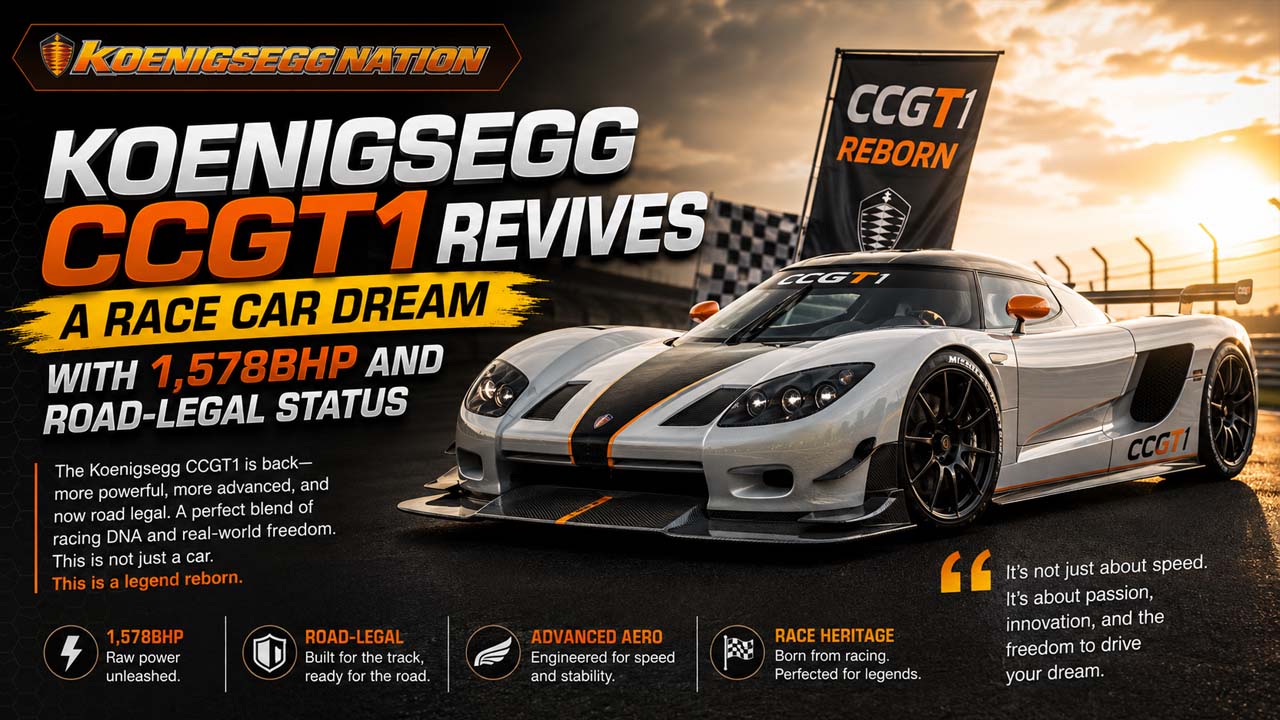
Bukemersanacokyakisir – The Koenigsegg CCGT1 Hypercar arrives with an unusual story behind its dramatic carbon body. It is road legal, yet Koenigsegg designed it with serious circuit driving in mind. More importantly, it celebrates the original CCGT, a competition machine that never actually competed. Koenigsegg developed that car for GT1 racing in 2007. However, regulation changes prevented the ambitious project from reaching the starting grid. Nearly two decades later, that unfinished chapter has inspired something new. The CCGT1 takes the character of that forgotten racer and combines it with modern hypercar engineering. Consequently, the result feels less like a nostalgic tribute and more like an alternative history brought to life. It has enormous power, sophisticated aerodynamics, and a deliberately focused cabin. Nevertheless, owners can legally drive it on public roads. That unusual combination immediately separates the CCGT1 from conventional track specials and makes its historical connection much more meaningful.
CC850 Architecture Provides the Foundation for Something Wilder
Underneath its completely redesigned exterior, the Koenigsegg CCGT1 Hypercar uses the CC850 as its technical foundation. That connection brings proven modern Koenigsegg engineering into a machine inspired by motorsport history. However, the visual relationship between the two cars is deliberately limited. Koenigsegg created an entirely new carbon-fibre body for the CCGT1. Therefore, its proportions and aerodynamic surfaces communicate a much more aggressive purpose. The roof scoop dominates the upper profile, while the huge rear wing instantly recalls the original CCGT. Meanwhile, the front splitter and carefully sculpted lower surfaces transform airflow around the chassis. This approach makes sense because the CCGT1 is not simply a CC850 wearing a racing body kit. Instead, it represents a separate interpretation of the platform. The engineering philosophy also reflects how Koenigsegg has evolved. Rather than chasing performance through horsepower alone, the company combines lightweight construction, airflow management, mechanical engagement, and advanced transmission technology to create a more complete driving experience.
Twin-Turbo V8 Delivers Up to an Extraordinary 1,578bhp
Performance begins with a familiar but formidable 5.0-litre twin-turbocharged V8. On regular petrol, the engine produces a remarkable 1,263bhp. Fill the tank with E85 biofuel, however, and output climbs to an astonishing 1,578bhp. Those figures place the Koenigsegg CCGT1 Hypercar comfortably within modern hypercar territory despite its old-school GT1 inspiration. Yet the engine is only part of its appeal. The enormous roof scoop feeds air toward the powertrain while also strengthening the visual connection with a competition machine. Furthermore, the CCGT1 avoids relying on electrification to achieve its extraordinary output. That gives it a distinctly mechanical personality in an era when many high-performance manufacturers are increasingly combining combustion engines with electric motors. For enthusiasts, this approach may be one of the car’s strongest emotional qualities. The CCGT1 does not attempt to hide its combustion-driven character. Instead, it celebrates it. The result is a machine that blends modern engineering capability with the raw theatre traditionally associated with powerful GT racing cars.
Also Read : Persib Send Henhen Herdiana to PSM in Search of Regular Minutes
Koenigsegg Sequential Shift Introduces a New Driving Experience
Perhaps the most intriguing engineering feature is the new Koenigsegg Sequential Shift system, or KSS. Rather than simply carrying over the CC850 transmission interface, Koenigsegg developed a racing-inspired setup for the CCGT1. Drivers use an actual clutch pedal when pulling away. Once moving, however, ignition cuts enable clutchless sequential shifts. Therefore, the system aims to recreate some of the mechanical involvement associated with the original GT1 machine. A large physical gear lever further reinforces that experience. Interestingly, buyers who prefer a traditional arrangement can select the CC850-derived ESS six-speed gated manual instead. This choice gives the Koenigsegg CCGT1 Hypercar two distinctly different personalities. The KSS prioritises motorsport theatre and rapid interaction. In contrast, the gated manual offers a more traditional connection between driver and machine. Such options are increasingly rare among extreme-performance cars. Consequently, Koenigsegg appears determined to make transmission choice part of the emotional experience rather than treating the gearbox simply as another tool for achieving faster acceleration figures.
Massive Adjustable Wing Helps Generate 800kg of Downforce
The enormous rear wing is not merely there for visual drama. It provides 30 degrees of adjustment and works together with several carefully engineered aerodynamic elements. These include a substantial front splitter, active underbody aerodynamics, and a sculpted underfloor. Combined, they allow the Koenigsegg CCGT1 Hypercar to generate around 800kg of downforce at 155mph. That figure explains why the exterior looks considerably more aggressive than the CC850 underneath it. More importantly, it highlights the car’s dual-purpose engineering philosophy. Downforce at this level can significantly improve high-speed stability and cornering performance during circuit driving. However, Koenigsegg still intends the vehicle to remain usable on public roads. Balancing those goals requires more than simply attaching larger aerodynamic components. Airflow, suspension behaviour, tyre performance, and overall balance must work together. From an enthusiast’s perspective, this may be where the CCGT1 becomes especially interesting. Its design does not merely imitate a GT1 racer. Instead, its aerodynamic package provides genuine performance benefits while preserving enough flexibility for road use.
The Cabin Feels More Like a Fighter Jet Than a Luxury Hypercar
Inside, Koenigsegg deliberately keeps the motorsport atmosphere alive. The driver faces the company’s third-generation Chronocluster display, while lightweight carbon-fibre seats and six-point harnesses reinforce the car’s circuit-focused personality. There is also an analogue G-meter, a fire extinguisher, and that enormous sequential gear lever. Meanwhile, starting the car involves controls that feel almost theatrical. A toggle primes the fuel pumps, a covered ignition switch prepares the system, and a red starter button finally awakens the V8. A touchscreen is still available, although digital luxury clearly takes second place to driver involvement here. This balance gives the Koenigsegg CCGT1 Hypercar an interesting identity. Modern hypercars often combine extreme performance with elaborate interiors and increasingly complex infotainment. Koenigsegg takes a different route. Technology remains present, but many controls deliberately create physical interaction. As a result, the cabin becomes part of the experience rather than simply a luxurious place from which to control an exceptionally fast machine.
An Official Track Pack Pushes the CCGT1 Even Further
For owners who consider the standard CCGT1 insufficiently extreme, Koenigsegg offers an official Track Pack. This marks the first time the manufacturer has created such a factory package. The upgrade includes a carbon roll cage, HANS-compatible seats, a racing steering wheel, and a dedicated racing exhaust. Additionally, buyers receive air jacks, more focused suspension, improved aerodynamic components, and track-oriented tyres. These modifications move the Koenigsegg CCGT1 Hypercar considerably closer to its competition-inspired roots. However, Koenigsegg goes further than simply delivering hardware. Track Pack customers also receive a dedicated circuit experience with factory support. That detail matters because cars operating at this performance level require knowledge as much as confidence. Professional guidance allows owners to explore the machine in a controlled environment while understanding its systems properly. Therefore, the Track Pack represents more than a collection of performance parts. It creates an ownership experience built around circuit driving, which seems particularly appropriate for a car designed to celebrate a GT1 racer denied its own chance to compete.
Ghost Fibre Adds Another Layer of Koenigsegg Experimentation
Another fascinating element is a material Koenigsegg calls Ghost Fibre. The distinctive white-fibre finish recalls the rare Trevita project introduced in 2009. However, the material is presented as more than a visual reference. According to Koenigsegg, Ghost Fibre can contribute ballistic protection, sound insulation, and low weight. Its appearance on the CCGT1 therefore connects two different chapters of the company’s history. Christian von Koenigsegg described the new model as a track-optimised circuit scalpel that can also function as an extraordinary daily driver. That description neatly captures the contradiction at the centre of the Koenigsegg CCGT1 Hypercar. It celebrates an uncompromising competition car while remaining usable beyond a racetrack. Meanwhile, experimental materials such as Ghost Fibre demonstrate that nostalgia has not prevented the company from exploring new engineering ideas. Instead of recreating the 2007 CCGT literally, Koenigsegg has taken its philosophy and applied almost two decades of technological development. In that sense, the CCGT1 represents evolution rather than simple retro design.
Only 70 CCGT1 Examples Will Exist, and Every One Is Spoken For
Koenigsegg will produce only 70 examples of the CCGT1, making exclusivity an inevitable part of its appeal. More remarkably, every production slot has already been allocated. For a company operating at this level of the hypercar market, that response is hardly surprising. The Koenigsegg CCGT1 Hypercar combines several qualities collectors increasingly value: rarity, historical significance, unconventional engineering, enormous performance, and a strong connection to motorsport. Yet its most compelling feature may be the story itself. The original CCGT represented a racing ambition stopped by circumstances beyond the manufacturer’s control. The CCGT1 finally gives that idea another opportunity to exist, although in a completely different form. It can travel on public roads, produce up to 1,578bhp, and generate 800kg of downforce at speed. At the same time, owners can configure it for serious circuit use. Nearly 20 years after the original racing project disappeared, Koenigsegg has transformed an unfinished chapter into one of its most distinctive modern creations.



Post Comment